
10% restaurants closed down, business down by Rs. 79,000 crore per month
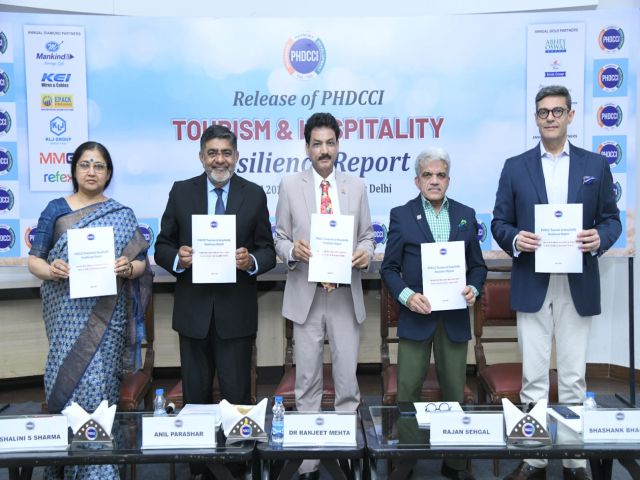
PHDCCI today released its report, ‘Impact of the West Asia Conflict on India’s Tourism, Aviation & Hospitality Sectors’, highlighting significant disruptions across aviation, inbound tourism, hospitality and restaurant segments, even as strong domestic demand continues to support overall sector stability.
India’s tourism and hospitality sector, which contributes nearly 8% to GDP and supports over 40 million jobs, is once again facing external shocks due to escalating geopolitical tensions. The report notes that while the sector had witnessed a strong V-shaped recovery in 2025, with branded hotel inventory nearing 200,000 rooms and domestic aviation traffic crossing 5 lakh passengers per day, the West Asia conflict in early 2026 has introduced fresh volatility.
The aviation sector has emerged as the most impacted, with airlines facing flight cancellations, airspace restrictions and significant rerouting of international flights. These disruptions have increased flying time by 2–4 hours on key routes, leading to a sharp rise in fuel consumption and operating costs. Industry estimates indicate that fuel accounts for 35-40% of airline operating costs and the ongoing situation has further strained airline profitability. The disruption of Middle East air corridors which is among the busiest global transit routes has also reduced connectivity efficiency and increased airfares.
The report highlights a 15–20% decline in inbound tourist traffic, particularly in leisure travel, as global travellers adopt a cautious approach amid geopolitical uncertainty. Outbound travel patterns have also shifted, with Indian travellers increasingly preferring short-haul destinations such as Thailand, Singapore and Vietnam, while long-haul and transit-dependent routes have seen moderation due to geopolitical risks.
The hospitality sector continues to remain resilient, supported by strong domestic travel demand. However, the report notes margin pressures due to rising energy costs, increased input prices and fluctuating international demand, particularly in premium and business hotel segments dependent on foreign travellers. Despite stable occupancy levels driven by domestic tourism, profitability remains under pressure.
The restaurant and food services sector is also experiencing a mixed impact. According to industry estimates aligned with insights from the National Restaurant Association of India (NRAI), the sector is facing input cost inflation in the range of 10–15%, driven by higher prices of imported ingredients, logistics and energy. Premium dining and hotel-based restaurants in
key tourism hubs have seen softening of international customer footfall, while domestic demand and food delivery contributing 20–30% of revenues for many organized players continue to provide stability. However, margin compression remains a key concern, especially for small and mid-sized operators.
Despite these challenges, domestic tourism continues to act as the primary growth engine, cushioning the sector against global disruptions. Travel trends such as revenge travel, staycations, bizcations and experiential dining are sustaining demand across hotels, airlines and restaurants.
To mitigate the impact and strengthen sector resilience, the report outlines several key policy recommendations. These include diversifying international air routes and reducing dependence on conflict-prone regions, enhancing bilateral air service agreements to improve connectivity and rationalizing taxation across aviation turbine fuel (ATF), hospitality and F&B sectors to reduce cost pressures. The report also calls for targeted financial support and easier credit access for MSMEs, which form a significant part of the tourism and restaurant ecosystem.
Further, it recommends accelerating infrastructure development, improving multimodal connectivity and promoting domestic tourism circuits to sustain demand. Strengthening digital travel facilitation, visa processes and destination marketing in alternative global markets is also highlighted as critical to offset declines in traditional inbound segments. For the restaurant sector, the report emphasizes the need to stabilize supply chains, reduce compliance burdens and support local sourcing ecosystems.
The report concludes that while the West Asia conflict has introduced short-term disruptions, it also presents an opportunity for India to build a more resilient, diversified and self-reliant tourism ecosystem. With strong domestic fundamentals and coordinated efforts between government and industry stakeholders, India’s tourism, hospitality and F&B sectors are well-positioned to navigate current uncertainties and sustain long-term growth.