
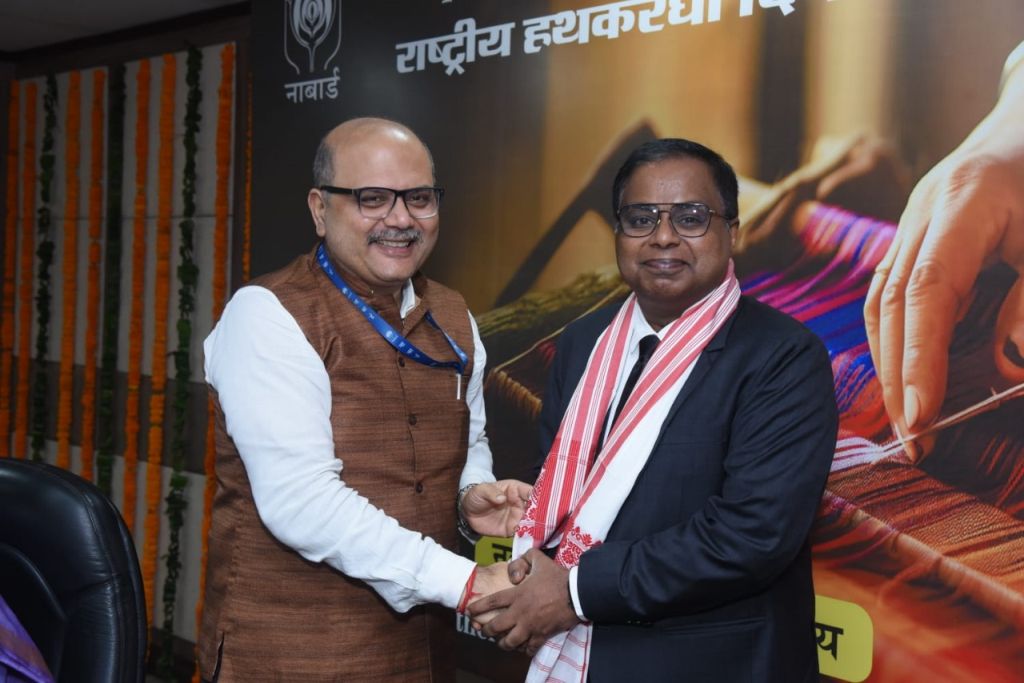
The National Handloom Day celebration is being organised by NABARD New Delhi Regional Office on 12-13 August 2025 highlighted the enduring legacy and cultural significance of India’s handloom sector. The inaugural function of the two-day event gathered key stakeholders from various sectors—government, financial institutions, academia, and the handloom industry— to discuss the future of the sector and explore strategies for promoting its growth.
The inaugural function on 12 August 2025 was co-chaired by Dr. M Beena, IAS, Deputy Commissioner of Handlooms, Government of India, and Shri Shaji K V, Chairman, NABARD. Key dignitaries who attended the event included Commodore Rajiv Ashok (Retd.), Managing Director of NHDC, Dr. Haragopal Yandra, MD NABCONS, Prof. Ashok Kumar Nagawat, Vice Chancellor of DSEU, Smt. Aditi Gupta, DGM RBI. The participation of representatives from SLBC, LDMs, Chairperson of Ambpali Handloom and Handicraft Multi-State Cooperative Society Ltd., and various weaver societies further enriched the dialogue and led to insightful exchanges on improving the sector.
One of the key highlights of the National Handloom Day was the exhibition, which displayed a wide range of traditional handloom products. Exhibitors included representation of different states like Uttar Pradesh, Madhya Pradesh, Tamil Nadu, Delhi among others. The products displayed ranged from Maheshwari and Kanjivaram sarees, Batik prints, and block print bedsheets, to readymade garments, woollen shawls, and organic food products.
Speaking on the occasion, Shri Shaji K V, Chairman shared his grassroots experience in the handloom sector, underscoring NABARD’s transformative role. He elaborated on the various initiatives undertaken by NABARD, particularly the reforms in cooperative banks and regional rural banks. These reforms include technology-driven interventions, digitization of cooperatives, and streamlining the credit disbursement process to make financial access more efficient for artisans and weavers.
He emphasized that handloom is not merely a craft but a narrative—one that can be woven with themes of sustainability, circularity, and cultural richness. NABARD’s support for Geographical Indication (GI) tagging, both in the pre-registration and post-registration phases, was highlighted as a significant value addition to handloom products. He also spoke about the Off-Farm Producer Organization (OFPO) initiative and NABARD’s commitment to working in challenging regions, promoting market-based solutions, building capacity, and scaling production with intent and purpose.
Dr. M. Beena expressed her appreciation for NABARD’s efforts in convening a diverse group of stakeholders, including weavers, artisans, bankers, government agencies, regulators, and NGOs—entities that often operate in isolation. She stressed that handloom is not just a heritage but a living heritage, pointing to the fact that India has over 35.22 lakh handloom workers, including 26.73 lakh weavers and 8.48 lakh allied workers. More than 70 percent of these workers are women, with the proportion rising to 74.5 percent in rural areas. Of the 31.45 lakh households engaged in handloom activities, 88.7 percent are in rural regions. A significant 73.2 percent of handloom workers operate independently, while only 6.3 percent are part of cooperative societies, and 19.4 percent work under master weavers.
She emphasized the growing relevance of handloom in the era of conscious consumption, slow fashion, and ethical production, which aligns with global movements toward reduced carbon footprints. She expressed delight at the overwhelming response to Handloom Day from stakeholders, NABARD, universities, and other institutions.
Congratulating NABARD on its initiatives in the GI sector and support for non-farmer producer companies, she called for greater collaboration across the sector between the GoI and NABARD. She emphasised that the journey of the weaver to the entrepreneur and to exporter needs support by various stakeholders. She also highlighted the importance of platforms like indiahandloom.com which serve as dedicated spaces for promoting authentic handloom products and connecting artisans with wider markets.
Sh. Nabin Kumar Roy, GM/OiC, New Delhi RO highlighted the role played by ecosystem enablers like NABARD, Government of India, NHDC and others in the sustainable development of handloom and handicrafts. He stressed upon the need to provide livelihood to weavers and develop the value chain of the sector.
Dr. Hara Gopal Yandra, MD NABCONS in his address highlighted the importance of the handloom sector and exhorted that we need to believe the handlooms, we need to help the rich heritage of the handloom products in India to make it more sustainable.
Commodore Rajiv Ashok (Retd.), Managing Director of NHDC in his address the importance of believing in the potential of the handloom sector and called for more efforts to preserve and promote India’s rich heritage. He suggested to promote and create awareness on handloom and handicrafts among school students to foster appreciation for traditional crafts. He also mentioned the need for post-Geographical Indication (GI) support, an area where NHDC is already active, and emphasized that improving the working conditions for handloom workers should be a priority for all stakeholders.
Representatives from various weaver societies, including the Ambpali Handloom and Handicraft Multi-State Cooperative Society, along with bankers, shared their insights and experiences, while also articulating their expectations from the government and NABARD.
 India’s small business owners honored at the Grand Premiere of Muthoot FinCorp SPARK Awards
  GREW Solar Wins ‘Solar Energy Manufacturer of the Year 2025’ at the Go Global Awards
  India’s pharma exports nearing $30 billion, with CRDMOs and GCCs driving next phase of innovation: EY-Parthenon–OPPI report
  360 ONE Asset appoints Pritam Doshi as CIO – Renewable Energy
  APM Terminals Pipavav Strengthens Rural Healthcare with 8,000+ Eye Care Beneficiaries
  CDSL kicks off Ideathon inviting students to reimagine investor education and engagement for Atmanirbharta